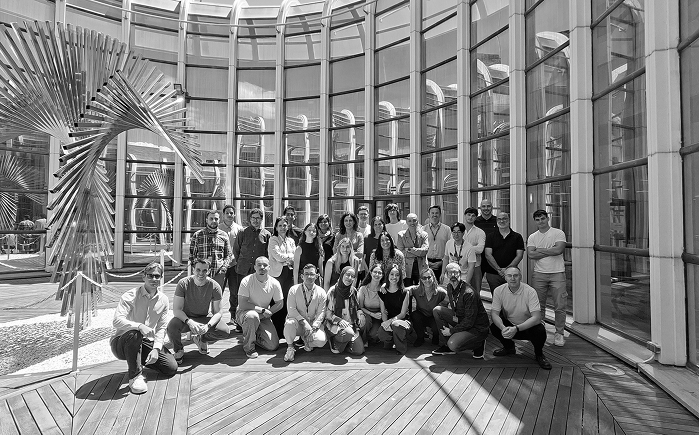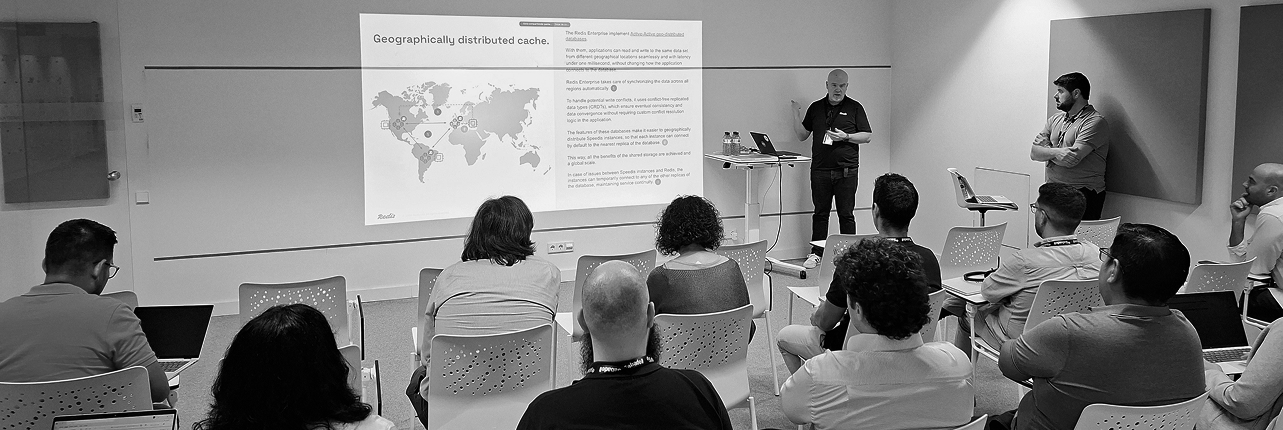
This was one of the reflections with which we opened the latest Sabadell Morning alongside Redis. And it is not a trivial question: in a digital environment, every millisecond directly impacts the customer experience, operational efficiency, and ultimately, the business.
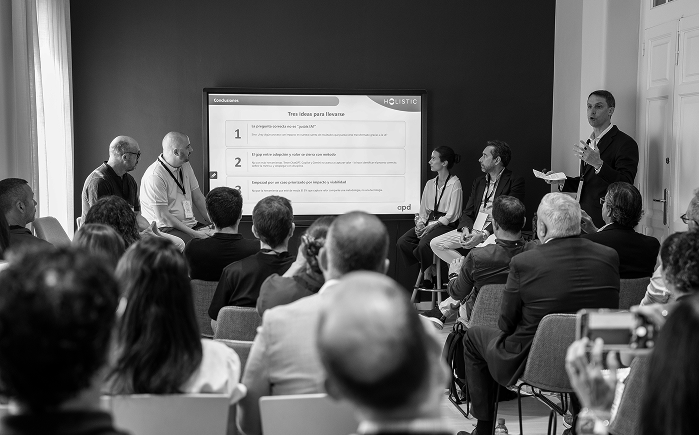
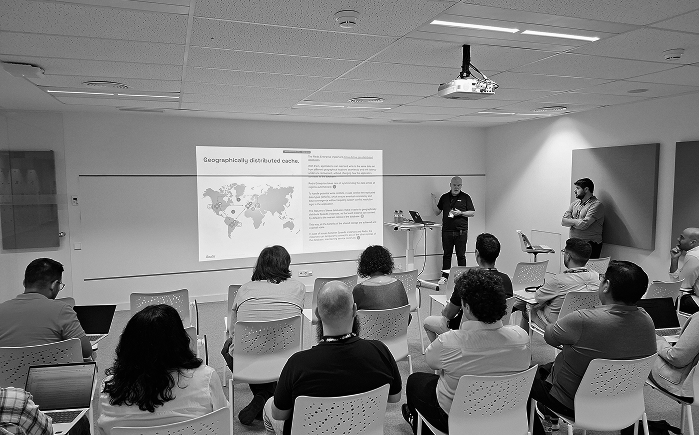
The session brought together over a hundred professionals in a hybrid format to reflect on a common challenge: how to evolve our architectures to be faster, more efficient, and better prepared for the future.
From cache to strategic data platform
One of the clearest messages we took away is that Redis is no longer perceived solely as a caching solution. We are talking about a real-time data platform capable of becoming a key component to:
- Reduce critical latencies in digital services and customer channels.
- Optimise structural costs by offloading legacy systems.
- Enable modern event-driven architectures.
- Accelerate the development and deployment of Artificial Intelligence (AI) use cases.
Technology at the service of real priorities
During the event, we explored how these capabilities fit directly with the bank’s strategic priorities: efficiency, modernisation, resilience and artificial intelligence.
Through practical sessions, we analysed how these principles translate into concrete applications within our technological ecosystem. The combination of Redis and Apache Kafka in the messaging stack to reinforce event-driven architectures stood out. Additionally, specific use cases in real-time fraud detection and the use of Redis as an accelerator for intelligent agents and copilots through RAG (Retrieval-Augmented Generation) architectures were addressed.
From Artificial Intelligence (AI) to architectural transformation
One of the most relevant areas was the role of Redis in the context of generative AI.
Beyond the model, the key lies in the efficient management of context, memory, and access to information. At this point, Redis is positioned as a key piece to improve response times, optimise token usage and enable more scalable architectures for agents and copilots.
The session also reaffirmed how these types of technologies fit naturally into our architectural evolution. Its integration with cloud-native environments such as Proteo4, its compatibility with legacy systems undergoing modernisation, and its capacity to operate in multicloud environments reinforce its role as a key component within a hybrid and transforming architecture. All of this in a demanding context of security, resilience, and regulatory compliance, where technology must be flexible, robust, and governable at the same time.
Learning together to build better
These types of sessions reinforce a central idea: technological evolution is not just a matter of architecture but also of people, knowledge and ways of working.
“Thanks to the Redis team and to everyone who participated in the session. It is a pleasure to hold these types of sessions which perfectly reflect how we work: being open to learning, contrasting approaches and collaborating with partners to keep moving forward. We take away many ideas and, above all, clear next steps to put them into practice alongside the best technology experts and thus continue driving a more agile, efficient architecture that is prepared to meet the bank’s needs.”
Juan Carlos Gálvez Martínez, Core Architecture Director
Moving towards faster, smarter, and more efficient systems involves continuing to build internal capabilities, learning from cutting-edge technologies, and fostering collaboration between teams. In an environment where every millisecond counts, the way we share knowledge, make decisions, and build the future of the bank together also counts.