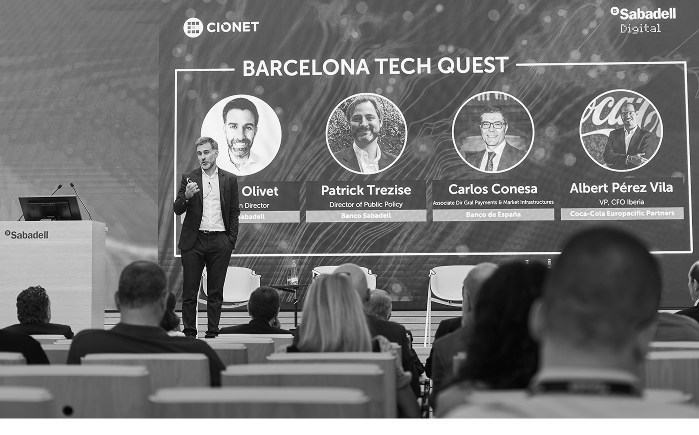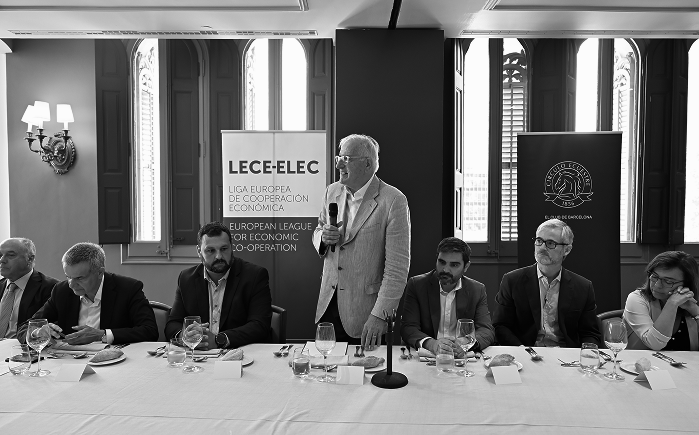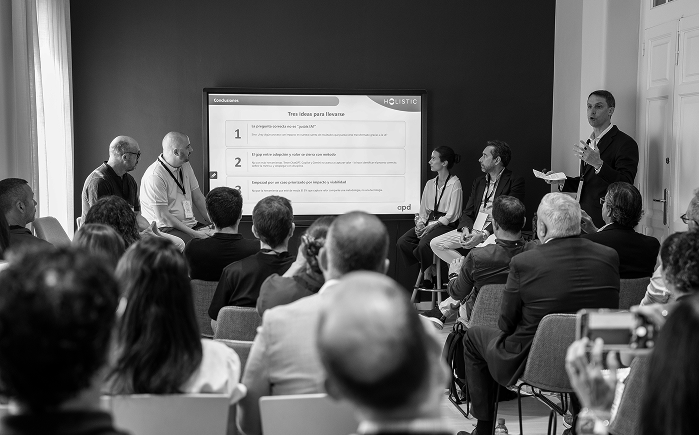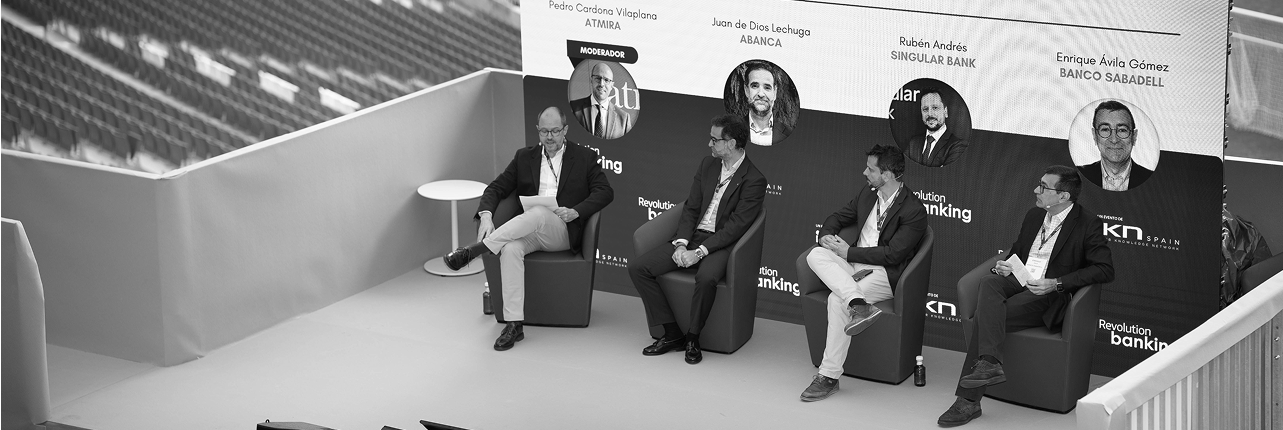
Revolution Banking returned to Madrid with a new edition focused on the transformation of the financial sector through technology. This time, the spotlight was on artificial intelligence (AI), digitalisation and the evolution of the banking experience. The event brought together financial institutions and industry experts to analyse how banking is addressing a transformation that is already fully underway.
Throughout the day, discussions were structured around panels covering AI industrialisation, the Agent Economy, technological modernisation and data management. Beyond the trends, the main message was clear: banking is no longer in an exploration phase, but in an execution phase. The current challenge is to turn innovation into real, secure and sustainable capabilities.
At Banco Sabadell, we had the opportunity to contribute a practical perspective on the operational, technological and cultural challenges involved, through the insights of our experts: Enrique Ávila, Víctor Cuervo, Pedro Cantalejo and Javier Martínez.
From AI Pilots to Real-World Operations
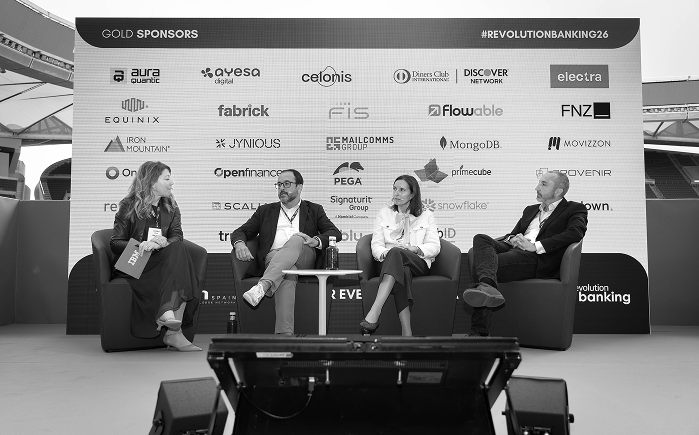
Pedro Cantalejo focused on one of the most recurring debates: why many agentic AI initiatives perform well as pilot projects but encounter difficulties when moving into production. The real leap is not technological but operational, and it requires incorporating:
- Observability and resilience.
- Continuous monitoring and oversight.
- Data quality and maturity.
The current challenge lies in the gap between the ambition surrounding AI and the actual maturity of data within organisations. To operate models at scale in real-world environments, Cantalejo explained that it is essential to have modern architectures, scalable platforms, cloud capabilities and multidisciplinary teams capable of connecting technology, business and operations.
“Agent Economy” and the New Banking Relationship Model
Enrique Ávila took part in the panel focused on the Agent Economy, which explored the emergence of intelligent agents and their impact on the financial value chain. Ávila analysed the concept of “SaaSapocalypse”, the result of three key factors driving the deployment of agentic platforms:
- Declining costs: A dramatic reduction in the cost of developing software in-house.
- Obsolete licensing models: The traditional per-seat or per-employee pricing model poses a threat to SaaS companies’ revenues.
- Disintermediation: Greater ease in eliminating third parties through the use of agents.
This ecosystem is tipping the balance of the “Buy vs Build” dilemma towards in-house software development. Ávila also highlighted that future differentiation will not depend on technology itself (which will become a commodity), but on how organisations integrate data and processes into the customer experience.
AI, New Operating Models and the Future of Banking
Javier Martínez participated in the panel “The Next Generation of Banking: AI, Data and New Operating Models”. He highlighted that agents powered by generative AI will transform the sector across two major dimensions:
- Customer experience: Through more agile, predictive and personalised interactions.
- Internal productivity: By optimising complex processes and improving decision-making.
Martínez also stressed the need to anticipate a disruptive scenario in which AI agents will themselves act as customers, requiring organisations to evolve towards adaptive and dynamic operating models. He concluded by emphasising that AI will not dehumanise banking, as relationships will continue to be shaped by the human needs of users.
AI, Structural Transformation and the Move to Production
Víctor Cuervo’s contribution provided a complementary perspective on the transition of artificial intelligence from an abstract concept to its practical application in operational environments.
Cuervo emphasised that the real transformation is structural: it involves fundamentally changing the way processes are designed and decisions are made. Success lies in moving from isolated use cases to adopting AI as a cross-functional capability throughout the organisation, while addressing scalability with rigorous operational discipline.
Technology with Real Impact and Internal Talent
The participation of Banco Sabadell professionals in forums such as Revolution Banking reflects the sector’s transition towards the effective development of new business models based on AI and data.
At Banco Sabadell, we continuously work to ensure that our teams remain at the forefront of innovation. This commitment translates into genuine growth opportunities within a cutting-edge technological environment, enabling our professionals to play an active role in addressing the major challenges that are redefining the future of finance.