There is a question we are hearing more and more in boardrooms, forums and business conversations: “How can we adopt Artificial Intelligence?” And, probably, that is no longer the right question. The real challenge is not adopting a technology, but changing habits, processes, ways of making decisions and ways of working.
Artificial Intelligence (AI) is not a magic layer that can be installed across an organisation to make it automatically more efficient. It only creates an impact when it addresses real problems, when people trust it and when it becomes a natural part of day-to-day work.
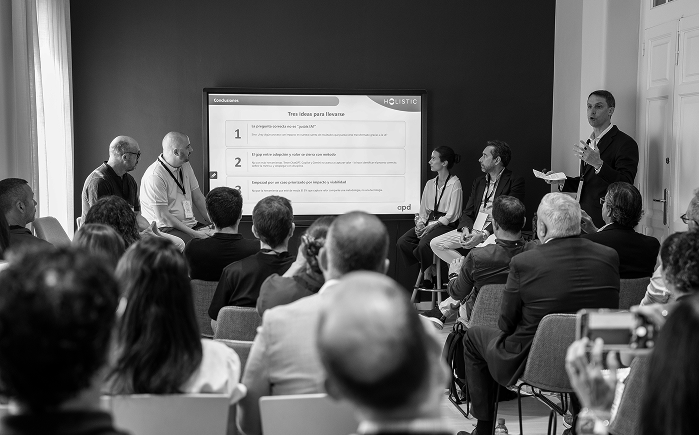
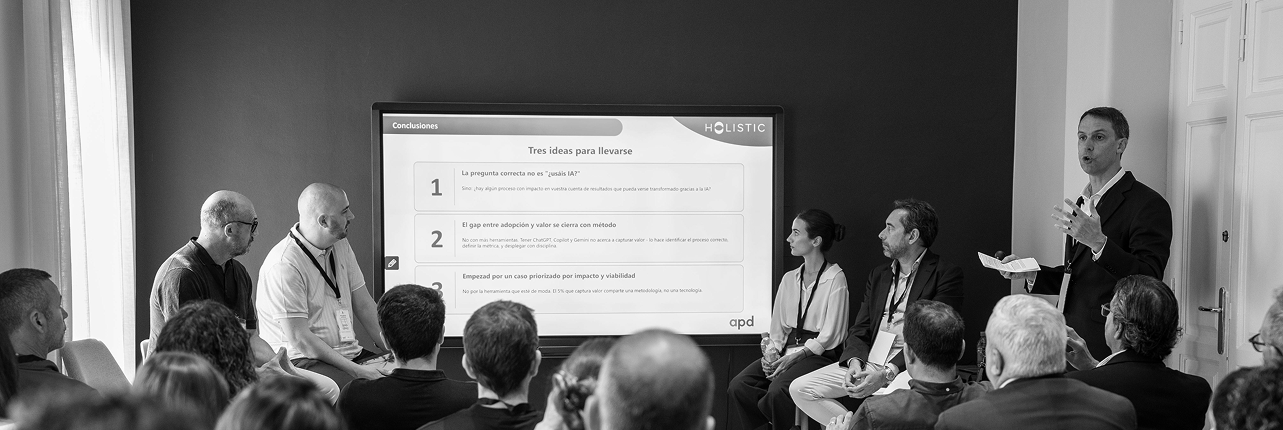
This was one of the central ideas I shared at the round table organised by APD and Holístic on AI adoption in business, which brought together professionals from very different sectors, including banking, logistics, legal services and digital education. The conversation left us with one clear conclusion: we are no longer at the stage of talking only about potential. The time has come to turn AI into real value.
AI as a driver of productivity and value for people
In the financial sector, the use of advanced analytical models is not new; they have been used for years in risk analysis, the optimisation of internal processes and fraud detection. What has changed radically is the emergence of generative AI and its ability to democratise advanced tools, making them accessible to a wide range of roles within organisations.
Today, we are no longer talking only about specialised technical teams. We are talking about professionals who use AI as part of their daily work to:
- Synthesise large volumes of information.
- Draft initial versions and structure documentation.
- Organise ideas or extract actionable conclusions from a meeting.
This is where true digital transformation begins: by freeing up time from repetitive tasks so that it can be reinvested in better advice, personalised service and more strategic decisions that strengthen customer trust. The aim is not to replace people, but to empower them, giving them back focus and the ability to exercise judgement.
Our vision is in no way to replace people, but to empower them so that they can focus on higher-value tasks and move away from all these manual tasks that waste their time. AI should not be seen as a threat, but as an opportunity to give people back time, focus and the ability to exercise judgement.
Shared learnings for responsible AI adoption
In our approach, we distinguish between three main areas of development: productivity tools for employees, AI projects applied to specific processes, and uses across customer interaction channels.
The latter requires particular caution: AI can bring greater efficiency to routine tasks, such as locating a branch or blocking a card, but it should not replace human advice when customers need support, judgement and personalisation.
The round table allowed us to compare this perspective with very different experiences. Eugeni Fibla (Bolian / Akoma), from the logistics sector, explained how predictive AI helps them anticipate demand and optimise a highly automated warehouse.
His key learning was very clear: start with a specific problem that “hurts”, with a direct economic impact and sufficiently structured data. Without data quality, technology loses its value.
The real challenge is not technical, but human
From the legal sector, Delia Rodríguez (Roca Junyent) highlighted the importance of governance, human oversight and controlling what is known as Shadow AI: the use of external tools without corporate supervision. Her reflection is particularly relevant to regulated sectors such as finance, where innovation needs to take place within a clear framework for security, compliance and information protection.
Eloi Noya (Founderz) brought a very practical perspective on training and automation. In his case, AI is enabling them to scale services for very large communities, as well as personalise learning proposals and experiences. He also highlighted a key point: middle managers need to understand what can actually be done with AI so that they can rethink their teams’ workflows.
This idea is fundamental. In a large organisation, the challenge is not only technical. It is deeply human. It involves the fear of making mistakes, uncertainty about what can and cannot be done, the difficulty of changing established routines, and the need to demonstrate practical value.
In two or three years, AI at the level of personal productivity will become invisible, transparent and integrated into our daily work. The question will no longer be whether you are using it, but how we were ever able to work without it.
Adoption starts with perceived usefulness
At Banco Sabadell, we are seeing that adoption is not about age, but perceived usefulness. Professionals with decades of banking experience work alongside younger people who have incorporated AI more naturally into their routines. The key is to connect both worlds: deep business knowledge and new digital capabilities. That is why we promote training, workshops, support and internal communities (Engage), where colleagues themselves share use cases and learnings.
When someone sees that a task that used to take them two hours can be completed in five minutes, always with professional oversight and judgement, the barrier to entry disappears. Adoption does not happen by decree. It happens when a person understands what the tool is useful for and how they can apply it to their work the very next day.
That is why the return on AI will not lie solely in major strategic projects. It will also be found in everyday tasks: summarising more effectively, preparing better for a client visit, reducing document-related friction, improving the quality of a draft, speeding up information searches or turning a long meeting into actionable conclusions.
From isolated projects to AI-enabled working habits
In a large organisation, small improvements that are successfully adopted and can be replicated can generate an extraordinary impact. But achieving this requires careful prioritisation. Not every idea deserves to become a project. In our case, use cases must meet clear criteria: return, feasibility, security, scalability and regulatory fit. Increasingly, they also need to originate within the business areas themselves, because these teams have the best understanding of the processes, pain points and real opportunities.
Looking ahead to the coming years, I also shared a conviction: AI applied to personal productivity will become invisible and form a natural part of our daily work. Just as we no longer ask ourselves whether we use the internet, email or collaborative tools such as Teams, there will come a time when the question will no longer be whether we use AI, but how we were ever able to work without it.
Artificial Intelligence does not always need big headlines. It needs good habits. It needs trust, methodology, judgement and people who are able to incorporate it responsibly into their day-to-day work.