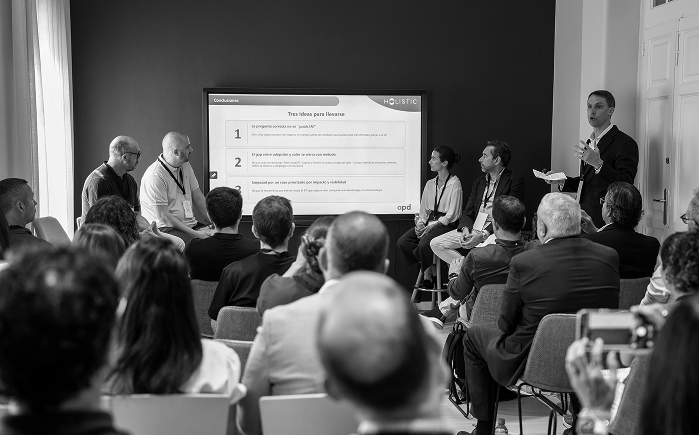
CIONET Barcelona Tech Quest 2026 brings together technology leaders in Sant Cugat to discuss digital assets, cybersecurity, artificial intelligence, and the role of technology on boards of directors. An event with an overarching theme: the challenge is no longer knowing what technology can do, but deciding what we are willing to change to make the most of it.
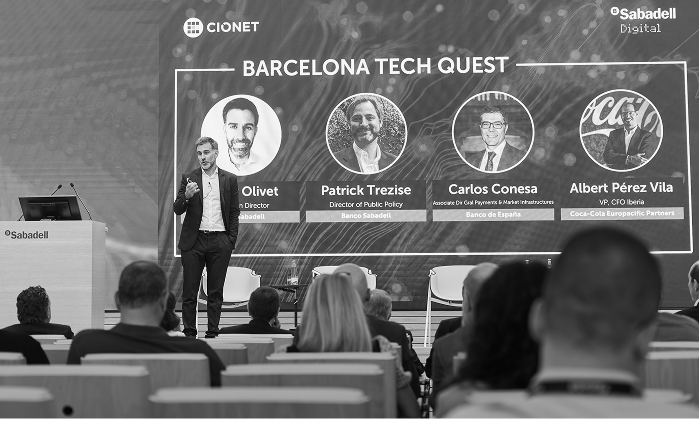
Technology has been promising to transform businesses for years. Now it is also beginning to transform how they make decisions, manage risks, and organize work. That was one of the central ideas of the third edition of CIONET Barcelona Tech Quest, held on October 6 at Banco Sabadell’s headquarters in Sant Cugat del Vallès.
Under the theme “Beyond the hype: from strategy to reality,” the event brought together technology leaders to address four major issues that ultimately converged on a single question: how can companies move from experimenting with technology to redesigning their organizations to unlock its full potential?
A more fragmented future for money and payments
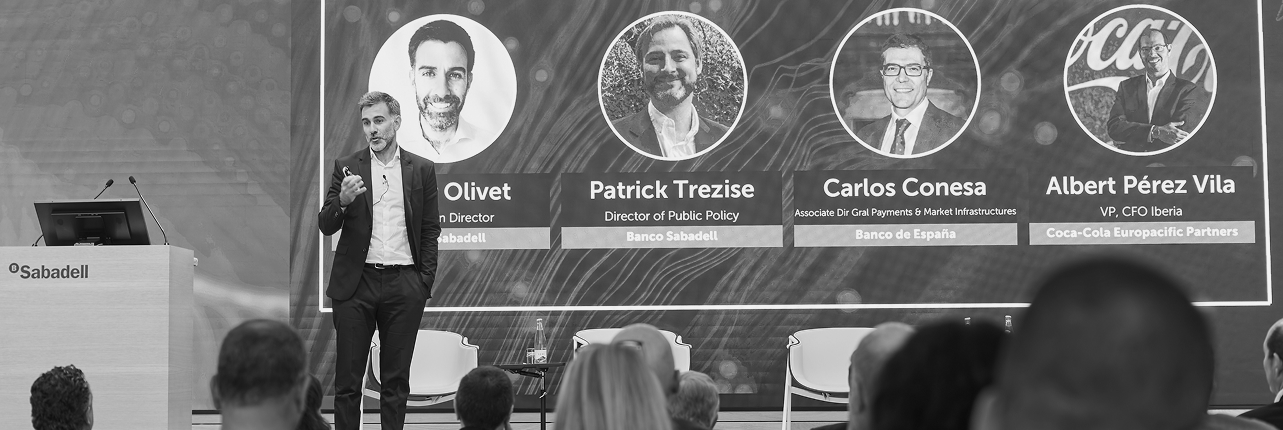
The event kicked off with a debate on the future of payments. Roger Olivet, from Banco Sabadell, outlined a scenario in which cash and cards will coexist with new alternatives such as the digital euro, stablecoins, and tokenized deposits. This scenario points to a more fragmented payments ecosystem, in which individuals and businesses will be able to choose different solutions based on factors such as cost, speed, security, or reach.
For his part, Carlos Conesa, from the Banco de España, discussed the digital euro as a digital alternative to cash. The proposal would enable payments between individuals, in physical stores, and online, with pan-European reach, without necessarily replacing physical cash.
The question, therefore, is not only what new forms of money will be available, but also what infrastructure will enable their use and how much autonomy Europe will have to develop its own systems.
AI reshapes the landscape of offensive and defensive cybersecurity
The pace of technological change once again took center stage in the security debate. Joan Puig, CISO of Banco Sabadell, and Javier Galindo, CISO of Moeve, analyzed how artificial intelligence is accelerating both cybercriminals’ offensive capabilities and companies’ defensive tools.
The speakers noted that the time available to respond to a threat has shrunk drastically:
- Traditional attacks: In past incidents such as WannaCry (2017), months could pass between the disclosure of a vulnerability and its widespread exploitation.
- Current attacks: With the help of AI, vulnerabilities can be exploited and social engineering attacks (through hyper-personalized phishing, deepfakes, or synthetic voices) can be carried out within hours.
Faced with this reality, the answer is not to slow down AI adoption, but to support it with clear security guidelines, with the CISO’s role evolving from an oversight role to that of an enabler of secure innovation.
The real leap forward: What if companies could learn?
Fernando Herrera, co-founder of Firemind, posed a question that sums up much of the debate: “Everyone in our organizations is using AI, but the question is: is the company itself using AI?”
Many organizations are still structured around the exchange of information between people. However, a significant amount of knowledge continues What to depend on employees’ accumulated experience. Herrera proposed exploring what would happen if organizations themselves could leverage that knowledge to learn and act more autonomously.
The approach goes beyond adding AI agents to existing processes. It is about enabling them to receive an alert, analyze it, decide how to act, and execute a response within defined limits. The goal is for AI to go beyond simply assisting employees and enable companies to rethink how work is distributed and carried out.
From technological potential to real change
The event painted a picture of a business landscape in which digital payments, cybersecurity, and artificial intelligence are changing the conditions under which companies operate. But it also highlighted a fundamental issue: new technological capabilities alone do not guarantee transformation.
Making the most of these capabilities requires reviewing processes, anticipating risks, developing new forms of collaboration, and aligning technological decisions with business strategy.
Going beyond the hype means no longer asking only what technology can do and starting to decide what needs to change within the organization to make the most of it.